D1 - Nurturing: Diferență între versiuni
Paul (discuție | contribuții) Ilustrații originale atribuite, corespondențe RO–EN, referințe și continuarea explorării ghidate. |
Paul (discuție | contribuții) Selecția autorului: doar harta cu personajele în expoziție; alte modificări curente păstrate. |
||
| Linia 13: | Linia 13: | ||
Food and personal context; sensory and informational input; questions about daily rhythms. [[Yin and Yang in food|Explore the traditional Yin–Yang food diagram]] and [[Daily rhythms and the organ clock|read about daily rhythms and the traditional organ clock]]. These are introductions, not a diet prescription. | Food and personal context; sensory and informational input; questions about daily rhythms. [[Yin and Yang in food|Explore the traditional Yin–Yang food diagram]] and [[Daily rhythms and the organ clock|read about daily rhythms and the traditional organ clock]]. These are introductions, not a diet prescription. | ||
== The chapter | == The chapter mind map == | ||
<div> | |||
<sdfigure id="d1-en-2" alt="D1 — chapter mind map from the English edition.">D1 — chapter mind map from the English edition.</sdfigure> | <sdfigure id="d1-en-2" alt="D1 — chapter mind map from the English edition.">D1 — chapter mind map from the English edition.</sdfigure> | ||
Versiunea curentă din 21 octombrie 2026 17:00
Nurturing — what feeds our life?
A meal is one starting point. In this framework, nurturing also includes the information we take in and the company in which we live. The invitation is to notice connections before rushing to a single answer.
An example, a question
Imagine two meals with the same ingredients: one eaten in a hurried argument, the other in a calm conversation. The example opens a question about context; it does not establish that a thought changes the medical effects of food.
What can we explore?
Food and personal context; sensory and informational input; questions about daily rhythms. Explore the traditional Yin–Yang food diagram and read about daily rhythms and the traditional organ clock. These are introductions, not a diet prescription.
The chapter mind map
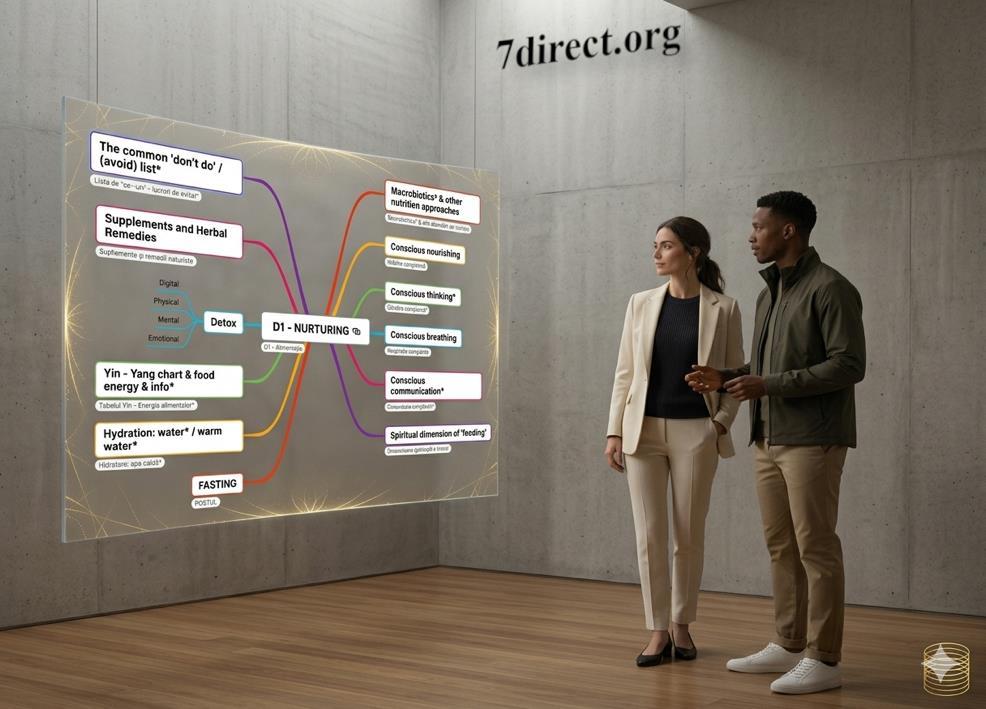
Ilustrații originale - Paul Gabor Iliescu
Original illustrations - Paul Gabor Iliescu
The illustrations introduce a guided conversation. Names of practices in a mind map are not evidence of medical efficacy.
Reading reference
Paul Gabor Iliescu, From Excruciating Pain to Life Lived to the Fullest — Intro into The 7 Directions of Health, Healing, and Abundance, chapter D1; and the beta book, D1. See both editions at Alfabet Genial.
← Previous Direction · Overview · OmniLayers · Next Direction →